
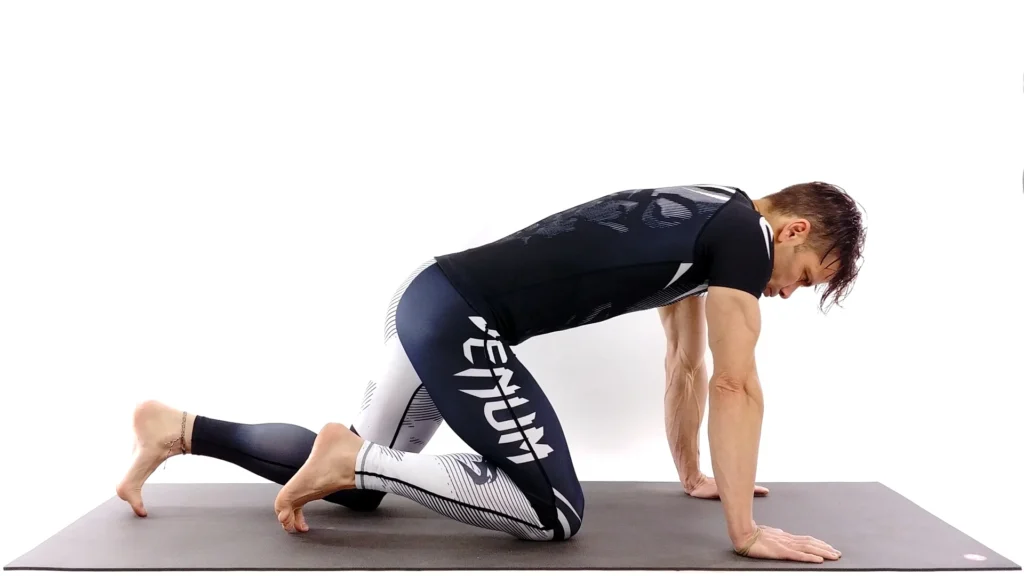
About SpineFITyoga
STRENGTH-FOCUSED, NEUTRAL-SPINE YOGA to heal NECK and BACK PAIN
Producing EXCEPTIONAL FITNESS
With 5-minute programs
At home
Two primary purposes
I designed SpineFITyoga so that almost anyone can heal spine pain (neck or back) at home.
At the same time, I wanted it to be a total body fitness program. And by fitness, I don't mean typical yoga flexibility, but rather strength, endurance, bone density, and joint stability. So SpineFITyoga is a different kind of yoga.
Why?
A brief history
Years ago, as a physical therapist who was particularly science-based and with extensive experience in strength and conditioning, I was blogging about spine pain. I was writing about the pros and cons of different treatments. And in doing so, talking about my method of total body strengthening done with a neutral spine, incorporating what was then the new research findings of spine biomechanist Stuart McGill and others.
I found the combination uniquely effective. And although I intended my blog to be read locally so that patients might come to my office, there were several issues.
- I was blogging on the world wide web, so the questions I received on my physical therapy website usually came from people around the world who needed help but were in no position to visit. People would often say my treatment approach made sense but was not available where they lived.
- It was not uncommon for them to say that the physical therapy they were getting, often stretch-oriented (Williams or McKenzie-based), was making them worse.
- People could try to follow my principles and routines on their own, but only if they had access or time to visit a well-equipped gym. Most didn't. So for them, my weights-based exercise routines weren't of much help.
- And nearby there were issues, too. I had a feeling that as much as I wanted my local patients to join a gym after therapy and keep up their exercises after therapy was finished, I knew that many, probably most, didn't. For legitimate reasons, such as time, cost, or other responsibilities, or since I favored free weights, venturing into the free weight room of a commercial gym can be a bit intimidating. But regardless, I really wanted people to make a lifestyle change and exercise.
- Also, everywhere physical therapy was getting ever more expensive. Insurance deductibles were increasing substantially, as were copays. So to go to physical therapy three times a week for a month was becoming like another car payment. And what if you didn't have insurance? You were out of luck because, with my overhead, cash pay wasn't generally affordable either.
And it's not like higher patient prices were allowing us therapists to live high on the hog. Insurance companies were not just raising costs for patients. At the same time, they were reducing reimbursement to the therapists. So they couldn't afford to waive out-of-pocket fees as was common practice in the days before managed care.
The number of insurance-approved visits was decreasing as well, so people were often discharged from treatment only partly better. And when you called in to speak with insurance agents, they would say a full resolution of pain wasn't a necessary outcome.
In 2016 I got the idea to create a therapeutic exercise program as good as my weights; ideally efficient, progressive, and total body, that could be implemented at home by virtually anyone. It took a lot of trial and error, not so much from the rehab perspective, as that was fairly easy. It helps that knowing what not to do is easily half of the battle.
But getting a bodyweight program good enough to rival weights? Good enough to want to continue for its own merit after pain is gone? That wasn't so easy. But in 2018 I had a breakthrough, resulting in my Level-3 exercises. Is it as good as lifting weights two hours per day on a 3 on 1 off split if you want to be a competitive bodybuilder? No. Yet few people's goals are that.
However, for all-around total body strength, stamina, and being lean all year, around an ideal body weight, and not to mention minute-per-minute results, S5 seems the clear winner. And it just takes a yoga mat and, for the ambitious, some place to do Pullups.
It turned out so much better than I expected that I made S5 my personal workout. And you needn't take my word for it. If you are past the rehab stage, feel free to test and equalize the time of progress, comparing weights, or stretch-based yoga against S5 with the FitTEST-3.
And let me tell you about yoga…
I was against yoga for all kinds of reasons that, to this day, are still not wrong. For example:
- When you study what causes neck and back pain, you'll learn that many, if not most, yoga “poses” are flat-out bad for your spine.
- Much sideways stretching of the knees and hips isn't doing their ligaments a lot of good either.
- As for Big E Enlightenment, or that cosmic consciousness experience? Not… very… common… in yoga class, though I would not say never.
However…
As for that artist, hippie, music festival, Burning Man scene, that often overlaps with the yoga world?
I love that stuff!
I came to like yoga philosophy too. I'm just saying the stretches are orthopedically unsound, particularly if you are already injured.
And by the way, if you read the Yoga Sutras of Patanjali (the original yoga text) compiled around 200 BCE, there isn't a single stretch in it. In it, an asana (which later became the name for yoga poses) was just a comfortable posture in which to meditate. See:
"Asana is a steady, comfortable posture."
Patanjali, Yoga Sutra 2:46
There were no stretches or contortions in any of the four Vedas or Upanishads either.
In fact, Brian Singleton, in his fantastically interesting book Yoga Body, documents that when Krishnamacharya was coming up with his flow style (vinyasa) yoga, he was copying the poses of British contortionists. He had seen them performed in circuses touring India during the British Raj, and he trained his group to perform them and entertain the Maharaja. Later, one of his star students, B.K.S. Iyengar, took those contortions to America and repackaged them as a sort of alternative medicine. He started a new craze, promising they cured just about everything, if you read his book. Which, of course, they didn't, but it wasn't entirely wrong either, at least not in intent, but we'll come back to that. Both Krishnamacharya and Iyengar didn't have a lot to say about OG yoga philosophy, nor that of famed yoga practitioners of more recent memory, like Ramakrishna or Ramana Maharshi (both of whom I like a lot).
And while there's no stretching in the Yoga Sutras, I did find this:
"Beauty, grace, strength, adamantine hardness, and robustness constitute bodily perfection."
Patanjali, Yoga Sutra 3:47
So despite healthy skepticism, I was into the yoga thing enough to travel to Goa, India, to do my Yoga Teacher Training in 2017, and I did enjoy it, even if it made my neck sore for months.
But outside of class, on Agonda beach, there was this guy who I think was a bartender, who ran up and did one set of as many pushups as he could. He definitely wasn't doing chaturanga dandasana but was repping out his pushups, hard and fast, as many reps as he could. Which, despite what I was teaching at the time in my first "Spinal Flow," his method was also my preferred way to do them. And afterward he sat and maybe meditated, looking over the ocean. I took a couple of pics with my phone [insert pics], and I remember wondering if it was that simple. And I have to think, mostly yes, which became one of the main principles I took, tested, and optimized to make F5.
With S5 you gave up the doing-everything-in-unison aspect that has some social benefits, but for results, S5 is night and day better. Interestingly, if you read Iyengar's Light on Yoga, he talks about using the body as weights, just like resistance exercise. So like I said, I appreciate the intent.
Here our own body acts as a weight-lifting apparatus, and the different directions in which it moves cause the various parts of the body to bear the weight and thereby gain strength.
B.K.S. Iyengar
Iyengart published this in 1966, and exercise science wasn't that well understood in the West yet either. So with F5, we're leveling this up. And as mentioned, despite considerable research to the contrary, physical therapists in America today are still delivering stretch-based rehab. It's a huge problem and, in my mind, is the number one reason that neck and back pain around the world is so often chronic and doesn't get better.
Also in Goa, the school's leader, who was super-cool but taught meditation only, suspected I might be correct about neck and back stretches injuring the spine. He had two herniated discs and said that's why he personally didn't stretch anymore.
So, SpineFITyoga is my way of bringing this all together. It's a way of making accessible, progressable, and affordable the safest but still most effective method of exercise for both fitness and rehabilitation of neck and back pain. At the same time, its physical rigorousness furthers yoga's original aim of optimizing health and wellness, among other things, in the service of one's mental faculties. Another good Iyengar quote fits well here.
"It will be noticed that the very first obstacle is ill-health or sickness. To the yogi, his body is the prime instrument of attainment. If his vehicle breaks down, the traveler cannot go far. If the body is broken by ill-health, the aspirant can achieve little. Physical health is important for mental development, as normally the mind functions through the nervous system. When the body is sick or the nervous system is affected, the mind becomes restless or dull and inert, and concentration or meditation becomes impossible.”
B.K.S. Iyengar
How SpineFITyoga works differently
- SpineFITyoga works by raising awareness as to what causes spine pain. This removes the mystery and thus helps you to consciously minimize damaging stresses, allowing the body time to heal. If you are wondering what is causing your neck and back pain, with about 90-95% certainty, this is overwhelmingly what's causing your neck and back pain. The link is text-heavy, but if you have spine pain, it's worth the 31 minutes it takes to read the in-depth version.
- Besides verbally teaching what causes neck and back pain, SpineFITyoga teaches you to feel for yourself what the safe postures are with its 5-minute Posture-5 (P5) program.
- SpineFITyoga works by increasing total body fitness in a spine-safe way. Once you understand what the bad postures are, so you can lessen them. And what the good postures are, you can feel for yourself how your spine is being held. Then the total body is challenged to progressively increase strength, endurance, and while we're at it, since form follows function, appearance (remember Sutra 3:47).
The factors work together synergistically. The awareness and application of good spine biomechanics provide an optimal condition for healing, so we feel better when we start to exercise. The right exercise increases strength and, at the same time, lets us practice good biomechanics. Increasingly strong core muscles brace and protect the spine, while strong hips, legs, shoulders, and arms then do the bulk of active work, again minimizing damaging stress on vertebral discs and ligaments. The increased fitness makes every movement in life easier, and keeping the spine more neutral becomes a habit you don't have to always think about.
The best is that SpineFITyoga was originally an hour-long routine. And all the while I shortened it, it kept getting better, all the way down to 5 minutes of exercise. And for what it's worth, I tested 4 minutes, and it wasn't as good.
Of course there are other things that SpineFITyoga is good for, as staying fit, without wrenching yourself, covers a lot of bases.
Where next?
Sign up for just $49 a year or $200 for a lifetime.
Or learn more about what, in fact, causes neck and back pain. Or if your pain is the wrong kind of pain, hopefully steer you in the right direction for help. Or the USER RULES, which are my best effort to keep you out of trouble as you start, but at the same time, moving forward. The USER RULES are also a how-to on knowing when to push forward or back off, as well as what constitutes a good pain or a bad pain. All of which are in the free area so you can make an informed decision before signing up.
*The 5 minutes of S5 is, as of now, based on 3 exercises per day being 2-min, 2-min, and 1-min, each. In L3 you'll probably be tired for longer, but you can rest as long as you want between exercises. Some do them all together; some hit each at different parts of the day.
If you are here for pain, when first learning the postural component (P5), it's an additional 5 minutes to complete. Unlike F5, P5 isn't at all tiring, so it is usually done all at once. However, when first learning P5, it's best to take your time to ensure you are doing the movements perfectly. P5, however, is like riding a bike, where once you get it, you can stop, ideally continuing with S5 indefinitely, either divided or together, which, unlike riding a bike, is more use it or lose it.
SpineFITyoga
First self-paced NEUTRAL-SPINE YOGA for Spine Health AND Total Body Fitness
- Fast: 5-minute per day, home programs.
- Expert: Designed by a Physical Therapist with 20 years clinical experience.
- Guaranteed: Results in 40 Days or Your Money Back.
