
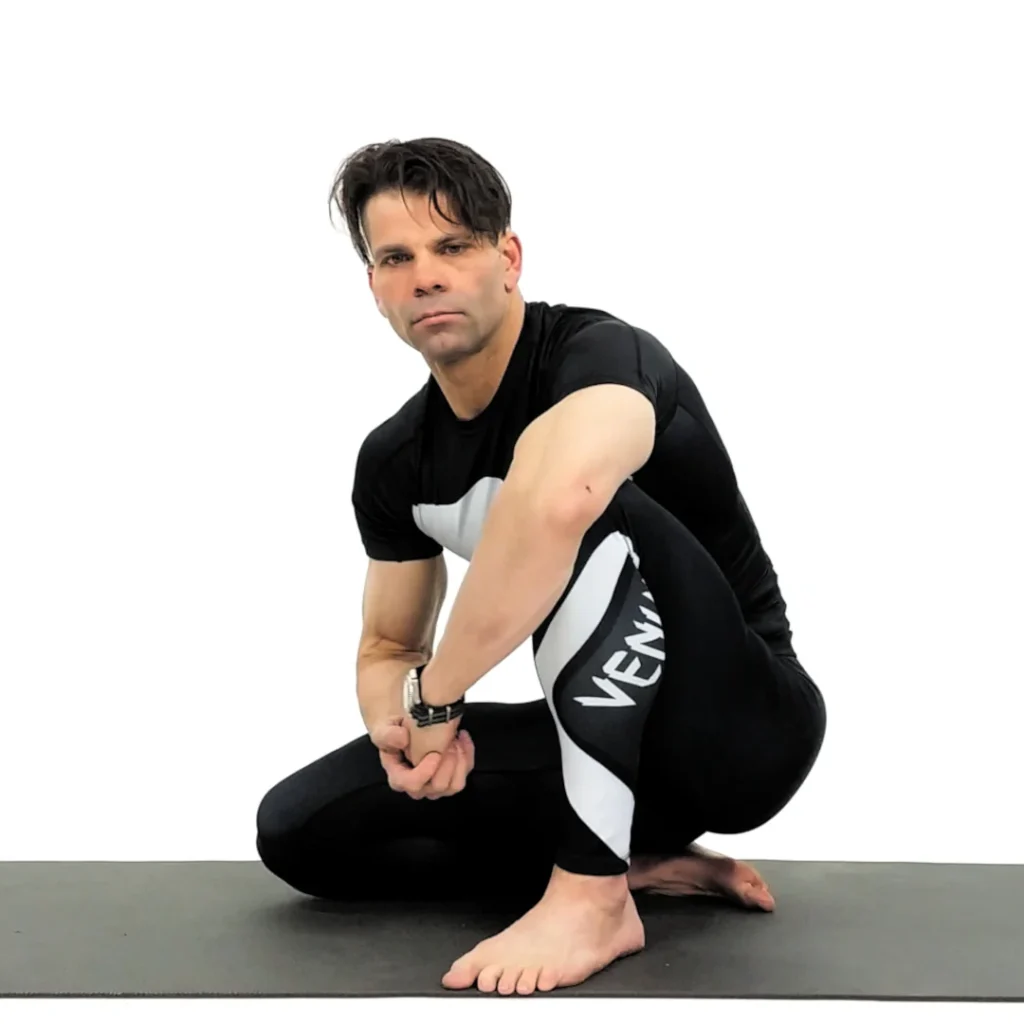
About Posture-5 (P5)
About Posture-5 (P5)
The above said, while S5 is SpineFITyoga's primary routine, and my personal workout, it isn't strictly spine rehabilitation. Nor is S5 exactly where I would tell someone to start if they currently had spine pain. Consequently, I wasn't sure about releasing S5 as a rehab workout. Part of what I removed from SFOne to make it faster and more effective for strength and stamina, was the slower, low intensity, neutral-spine posture, awareness, and coordination work. Work that's crucial if you have pain and are lacking said posture/awareness/coordination, and unfortunately most people with spine pain are lacking it all.
I also knew people with spine pain would have as many, if not more, barriers preventing exercise as anyone else, and I was sure that like me, most would prefer S5 over the longer routine. So I had to figure out how to make F5, and SpineFITyoga as a whole, work for people currently in pain, as that was, and still is, my primary focus. Yet I didn't want to dilute the effectiveness of F5. To solve the problem, I reduced the Level-1 intensity of S5 so that it's easier for beginners to start, leaving level 2 much the same and I keep learning ways to make L3 harder. At the same time I took what I liked best from S5 (efficiency) and streamlined SFControl into SpineFITyoga Posture-5 (P5) to explicitly teach ideal neutral spine posture in varied positions (minus the competing focus on fitness) in a 5-minute sequence also. I reasoned that as with F5, a 5-minute sequence done frequently, would be infinitely more effective than a longer exercises not done at all.
Together P5 and S5 are a very a complete and customizable spine rehabilitation and all body fitness system. Good enough for the vast majority of spine pain sufferers, unique, and for which I don't know of any viable competitors. What's cool about P5 is that once the spine recovers, and when P5 techniques are internalized, P5 can be omitted, leaving just S5 to be continued. Which will take one's fitness about as far as most would want to go, but still implicitly reinforcing the neutral-spine awareness and coordination achieved with explicitly with P5.
My suggestion is for people with current pain is to start P5 first, use the stick as a cue to lock down, understand, and feel what a neutral-spine is. At the same time preview the videos of S5 and think about what you can start with, without aggravating your condition. Then when you can do the P5, without the stick, and without any increase in pain, using the axis hand positions to maintain a neutral spine, then begin some or all of F5. Many, perhaps most, will be able to start S5 within a few days of P5, but be sure to keep the USER RULES in mind. When you can easily do P5, keeping the spine in perfect positions without the stick or hand positions, P5 can be discontinued.
I should add that while P5 is designed for people with spine pain, it's not only for people with spine pain. Poor spine awareness and motor control is common in those without pain also, thus learning P5 will go a long way towards prevention of future injury and degeneration, being well worth the short time it takes for most anyone to learn.
How Posture-5 (P5) works
Like F5, P5 only takes 5 minutes to finish. Even better, P5 is easier to learn, perform, and explain than F5, but is important for those who have, or recently had, neck or back pain. Learning P5 will go a long way towards prevention too, so it's well worth the time it takes for anyone to learn. But, if you currently an injured spine, perfecting P5 is likely necessary, both for optimal recovery and to prevent relapse.
With P5 you're not trying for exertion, rather technical precision, so it's also a good place to start if looking at the S5 videos you're thinking, no way. Unfortunately, P5 won't make you strong, but it will teach what postures and movement patterns keep the spine healthy, allow it to heal, and lessen pain, so strength can better advance with F5.
Therefore, think of P5 as the yin to F5's yang. Where you are learning what not to do, as much as what to do. Learning how to NOT bend and twist your spine while standing, moving, sitting, lying down and rolling over, etc.
Twisting and bending the spine is seemingly no big deal if alls well, but overdone, either sustained, repeated, or with too much load, are the primary causes of spine injury and pain. And after which everyone, physicians included, often think, it came out of nowhere.
SpineFITyoga
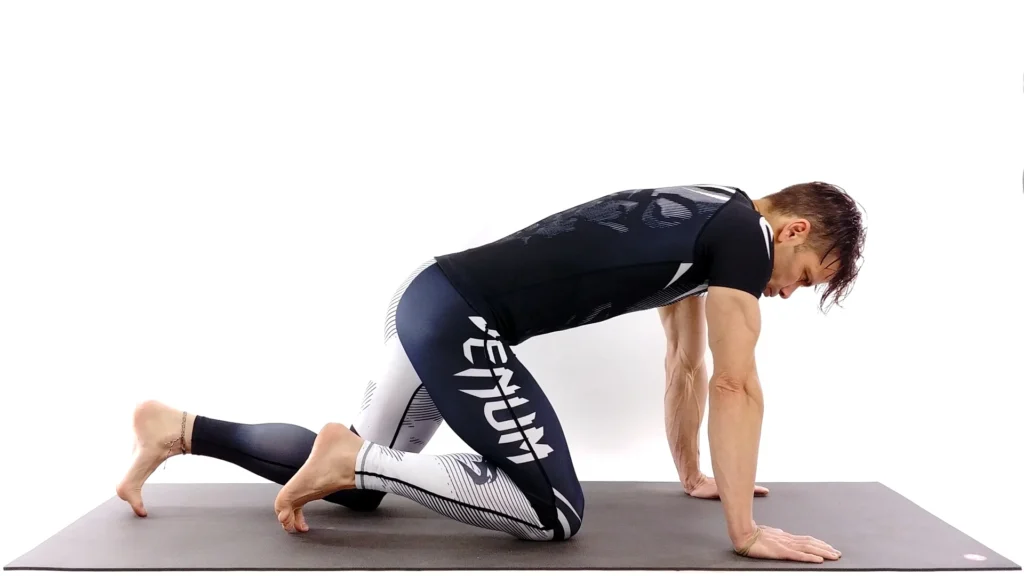
First self-paced NEUTRAL-SPINE YOGA for Spine Health AND Total Body Fitness
- Fast: 5-minute per day, home programs.
- Expert: Designed by a Physical Therapist with 20 years clinical experience.
- Guaranteed: Results in 40 Days or Your Money Back.
